
SUBSCRIBE.
Sign up for my newsletter. Filled with blogs, discounts, events and other news. 1 – 2 per month, max.
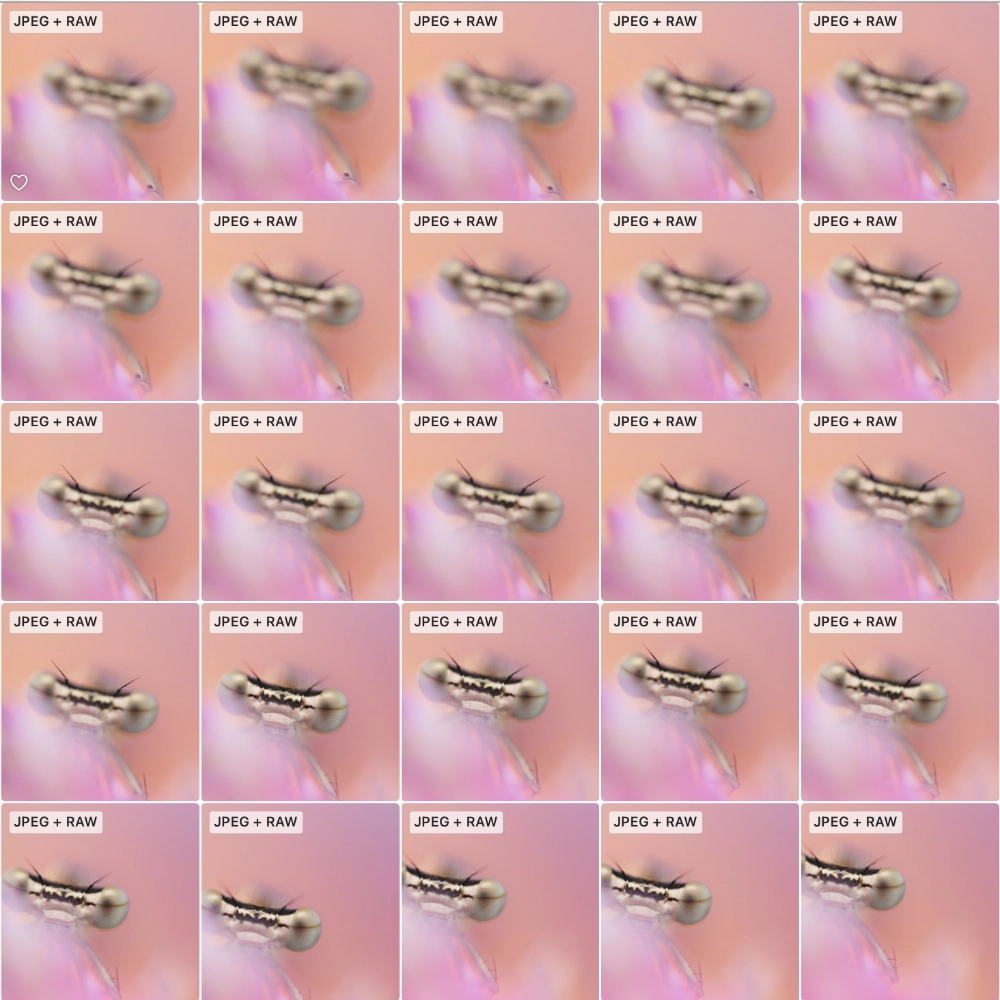
I’ll admit it: I’ve been guilty of it too. I’ve used the terms focus bracketing and focus stacking as if they mean the same thing, while they’re actually two different steps in the same process.
To make it even more confusing, camera manufacturers and macro photographers often throw these words around pretty loosely as well.
In this post I’ll give you a straightforward breakdown of the difference so you’ll never mix up focus bracketing and focus stacking again.
When you photograph something tiny, like a bee, up close with your lens zoomed in, you quickly realise: wow, that depth of field is razor thin. Maybe just the tip of the antenna is sharp while everything else turns into a blur.
Naturally, you’ll start looking for ways to get more of the subject in focus. That’s when you’ll come across focus stacking: a technique where you combine the sharp parts of multiple photos into one detailed final image. How to actually do that? That’s something I explain in another blog about focus stacking.
But before you can stack, you need something to stack with, and that’s where focus bracketing comes in.
Focus Bracketing
Focus bracketing is the capturing process: the camera (or you) takes a series of shots, shifting the focus point slightly with each one. Each image captures a different slice of the subject in perfect focus.
Focus Stacking
Focus stacking is the merging process: you combine the sequenced shots into a single image, keeping only the sharpest parts from each photo.
Seems simple enough, right? So why do people still mix them up?
That’s because they’re two parts of the same workflow. Bracketing always comes first, stacking comes after. You can either let your camera handle the bracketing automatically, or you can do it yourself manually (by carefully moving the camera between shots).
With in-camera stacking, the camera handles both steps automatically: bracketing first, then merging. It’s often simply called ‘Focus Stacking‘ in the camera menu.
When you hear terms like handheld stack or manual stack, here’s what they really mean:
And yes, that means the technically correct full phrase could be ‘a handheld stack created by manual bracketing’. A bit of a mouthful, which is why most people just say handheld stack.
To avoid confusion, I often simply say stacked image when sharing my photos, so it’s clear the viewer is looking at a composite made from multiple shots and it’s not a single shot.
Some cameras offer built-in focus stacking, where the camera automatically combines a series of focus-bracketed shots into one final image. No post-processing software like Affinity Photo required.
Sounds convenient, right? Here’s why I still never touch it.
Limited shots: Most cameras cap it low, the OM-1, for example, only does 15 frames. I regularly stack 50–100 shots for my images, so that’s a non-starter.
Movement kills it: Since I shoot handheld 99% of the time, there’s always some motion. The camera chokes on this and spits out an error, while I can easily align and blend those same shots in post.
In-camera stacking works fine for dead-still subjects on a tripod, but for deeper stacks with slight movement? It just doesn’t cut it.
For now… that is. Because who knows what camera manufacturers come up with in the future!


Sign up for my newsletter. Filled with blogs, discounts, events and other news. 1 – 2 per month, max.